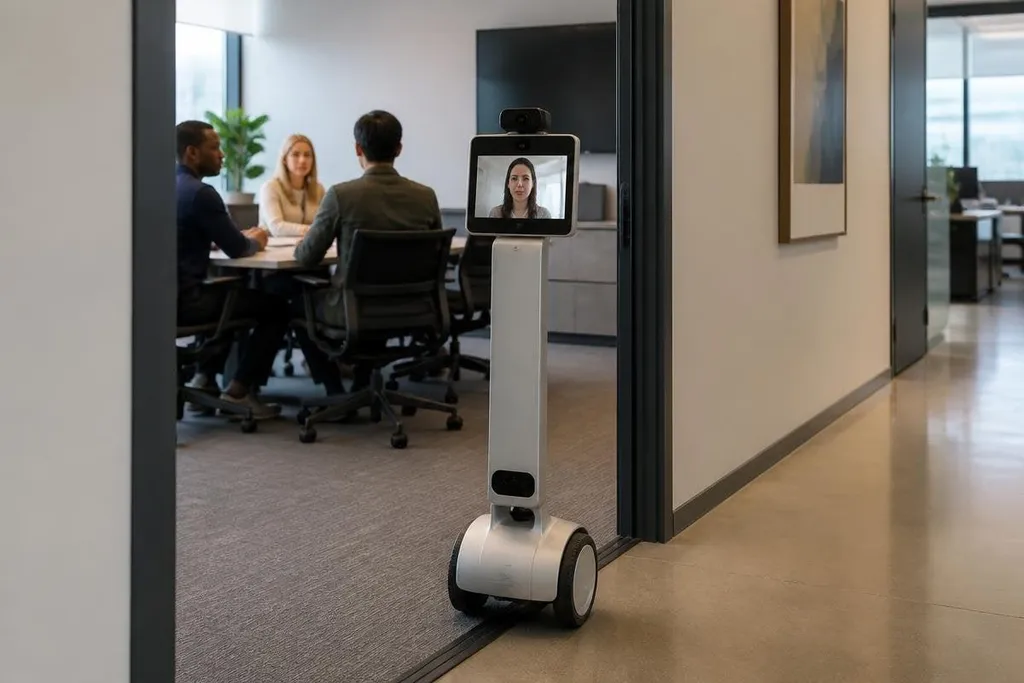
Telepresence robots let a person see, hear, and move through a distant place from a screen. AI is changing the work around that person by helping the robot avoid obstacles, frame video, understand speech, and handle small movements.
The person still makes the important decisions. That limit matters when a robot enters a hospital, office, classroom, or work site where a wrong turn can cause real trouble.
Quick read
- AI can handle routine driving, obstacle checks, and camera control while a remote operator watches.
- Speech and vision systems can make remote conversations easier, but they can also misread people or objects.
- The buyer still needs to check privacy, network quality, safety controls, and human backup.
What AI changes inside the robot
A basic telepresence robot follows commands from a remote operator. A remote user steers with a screen, keyboard, joystick, or mobile device, while cameras and microphones send the scene back.
AI can take over small parts of that loop. Computer vision can detect a wall, chair, person, or doorway.
Mapping software can help the robot estimate its position and plan a route through a known building. The operator may choose the destination while the robot handles the turns between rooms.
That division cuts the number of small steering commands the operator must send. It also gives the robot a way to stop when its sensors detect an obstacle. The exact result depends on the cameras, depth sensors, map, software, and network connection fitted to the robot.
Remote meetings become less mechanical
Telepresence is often used for meetings, teaching, patient contact, and site visits. In those settings, the robot needs to do more than move. It needs to keep the right person in view and make conversation easy.
AI can help the camera follow a speaker, reduce background noise, turn speech into text, or translate a conversation. These tools can lower the work needed from the remote user, especially when they must focus on a discussion rather than the robot's wheels.
The limits are easy to miss. A camera system may follow the loudest voice instead of the person who matters. Speech software may struggle with accents, room noise, or several people talking at once. Translation can also change the meaning of a short technical answer.
That is why AI should assist the meeting rather than decide what the remote user sees or hears. A remote user needs clear manual control and a way to turn automated features off.
The network still sets the pace
A telepresence robot depends on a live link between the robot and the remote user. Video must travel to the operator, and steering commands must travel back. Delays make driving harder, while a weak connection can freeze the image or drop control.
AI can reduce some of that strain by processing sensor data on the robot. This local processing is often called edge computing. It can let the robot detect an obstacle or keep a safe stop even when the remote video link has a delay.
Local processing doesn't fix every network problem. A robot may stop safely, yet the operator may not know what blocked its path until the video returns. Any buying decision should separate safety functions from convenience features and check which ones work without a live connection.
An AI feature on a telepresence robot can change who controls the camera, microphone, and drive system when the operator loses the link. Robot24.com can report those control rules beside the system’s data settings, leading to the next question: who owns privacy and safety when the robot acts alone?
Privacy and safety need a clear owner
Cameras and microphones can collect personal information during a remote visit. AI adds another layer when software stores video, identifies objects, transcribes speech, or sends data to a cloud service.
The buyer should ask where recordings go, how long they remain there, who can access them, and whether the system can run without storing audio or video. A written policy matters more than a product page saying the robot is smart.
Safety needs the same plain treatment. The robot should have a physical stop, clear status signals, speed limits for shared spaces, and a recovery plan for lost control. A person on site may still need to move it, charge it, or clear an object from its path.
A practical buying checklist
Use these checks before choosing a telepresence robot with AI features:
- Test the route: drive through the real rooms, doorways, lifts, and floor surfaces.
- Check manual control: confirm that a person can steer, stop, and recover the robot without AI assistance.
- Measure network needs: record where Wi-Fi or mobile coverage drops inside the building.
- Review data handling: ask about recordings, cloud processing, user access, and deletion.
- Check human backup: name the person who responds when the remote operator loses control.
I'd treat AI in telepresence robots as a control aid, not a replacement for the remote person. The systems worth buying will show what runs locally, what needs a network, and what happens when either one fails.